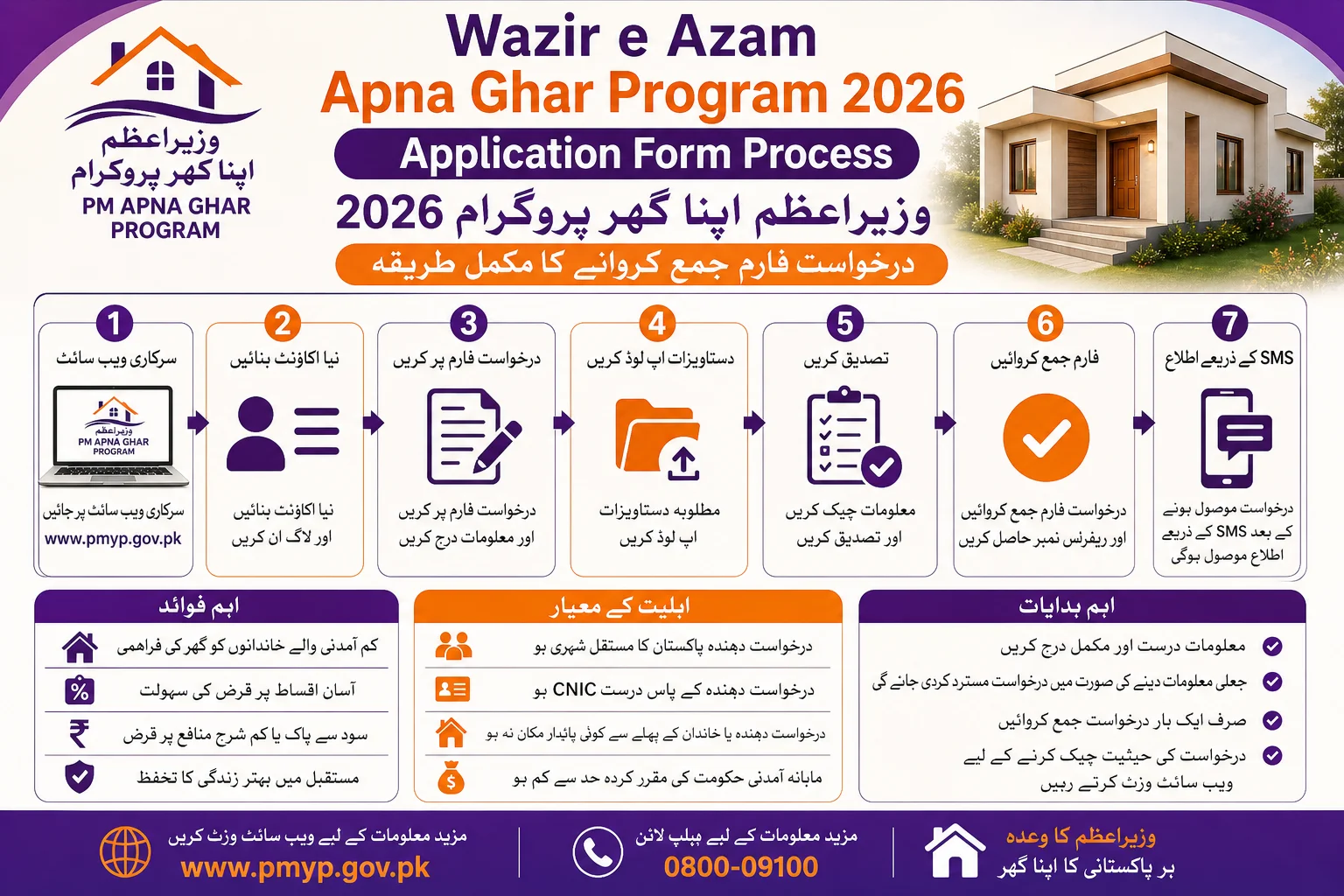
A Step Towards Homeownership: Exploring the “Apna Ghar Program”
The Prime Minister Apna Ghar Program: Ghar Hoto Apna represents a significant federal government initiative designed to foster affordable homeownership across Pakistan. This new Markup Subsidy and Risk Sharing Scheme directly addresses the housing deficit, providing crucial financial support to citizens aspiring to own a home. The overarching goal of the scheme is to make housing finance accessible and affordable, bridging the gap between desire and reality for countless families.
This comprehensive scheme extends its benefits to various housing needs. It facilitates the purchase of existing houses and flats, as well as plots for future construction. Furthermore, individuals who already own land can utilize the program’s provisions to finance the construction of their homes, ensuring flexibility for diverse circumstances.
Understanding the “Apna Ghar Program: Ghar Hoto Apna” Initiative
Introduced with the vision of empowering citizens, the “Apna Ghar Program: Ghar Hoto Apna” aims to make housing affordable through a tiered financing structure. It targets properties up to 10 Marla or flats sized up to 1500 sq. ft. This specific sizing ensures the program benefits a wide segment of the middle and lower-middle-income groups.
The government has committed to a maximum loan size of up to PKR 10 million under this scheme. A standout feature of the “Apna Ghar Program” is the fixed customer/end-user pricing set at a flat 5 percent. This predictable, low-interest rate protects borrowers from market fluctuations, enhancing financial security over the loan duration.
آنلائن اپلائی کے لیے یہاں کلک کریں
Click Here to Apply Online
Key Features of the “Apna Ghar Program”
The “Apna Ghar Program” distinguishes itself through several key features engineered to facilitate homeownership. These elements are designed to reduce financial burdens and enhance accessibility for eligible applicants. From competitive financing to transparent charges, every aspect aims to support the end-user.
The scheme prioritizes clarity and affordability throughout the loan process. It removes common financial barriers, allowing more individuals to pursue the dream of owning a home.
“Apna Ghar Program” Eligibility Criteria
Eligibility for the Prime Minister Apna Ghar Program: Ghar Hoto Apna is clearly defined to ensure the benefits reach those who need them most. Applicants must be citizens of Pakistan holding valid CNICs. Crucially, they must be first-time homeowners, meaning they should not own any housing unit in their name prior to applying for the scheme.
This criterion ensures that the program genuinely supports individuals and families who are yet to step onto the property ladder. The focus of the “Apna Ghar Program” remains on expanding first-time homeownership, contributing to broader socio-economic stability.
Scope and Housing Unit Sizes under “Apna Ghar Program”
The scope of the Prime Minister Apna Ghar Program: Ghar Hoto Apna is broad, covering multiple housing scenarios. It includes the direct purchase of a house or flat, the construction of a house on an already owned plot, and even the purchase of a plot followed by house construction. This flexibility ensures the “Apna Ghar Program” caters to various applicant needs.
Housing unit sizes are capped to maintain affordability and target specific segments. For houses, the limit is up to 10 Marla or 2,720 sq. ft. Flats, on the other hand, are eligible if they are up to 1500 sq. ft. These limits are central to the “Apna Ghar Program” philosophy.
Financial Mechanics of the “Apna Ghar Program”
The financial framework of the Prime Minister Apna Ghar Program: Ghar Hoto Apna is structured to provide substantial long-term relief to borrowers. Loans are available for an extended tenor of up to 20 years, offering ample time for repayment. A significant component of the “Apna Ghar Program” is the government’s markup subsidy, which covers the first 10 years of the loan.
During this initial period, end-users will pay a flat markup of only 5 percent. In contrast, the bank’s actual pricing is calculated as one-year KIBOR plus 3 percent. Moreover, a major benefit under the “Apna Ghar Program” is the waiver of all processing costs and prepayment penalties, further reducing the financial strain on borrowers.
Loan-to-Value Ratio and Risk Coverage in “Apna Ghar Program”
A favorable Loan-to-Value (LTV) ratio of 90:10 is a cornerstone of the “Apna Ghar Program.” This means borrowers are only required to contribute 10 percent equity, while the loan covers 90 percent of the property’s value. This significantly reduces the upfront financial barrier for potential homeowners.
In a move to incentivize financial institutions, the government provides robust risk coverage. This amounts to 10 percent of the outstanding loan portfolio under the “Apna Ghar Program,” offered on a first-loss basis. This mechanism reduces risk for lenders, encouraging their active participation in the scheme. Many details of this scheme can be found at NewSchemes.com.
Participating Financial Institutions for the “Apna Ghar Program”
To ensure widespread accessibility for the Prime Minister Apna Ghar Program: Ghar Hoto Apna, a broad network of financial institutions has been designated. These include all commercial banks, Islamic banks, and microfinance banks (MFBs). The House Building Finance Company Limited (HBFCL) is also a key participant in the program.
These Participating Financial Institutions (PFIs) are crucial for the successful implementation and reach of the “Apna Ghar Program.” Their widespread presence ensures that individuals across different regions can access the highly beneficial housing finance scheme.
Impact and Vision of the “Apna Ghar Program”
The Prime Minister Apna Ghar Program: Ghar Hoto Apna is poised to have a transformative impact on Pakistan’s housing sector and economy. By making homeownership more attainable, it is expected to uplift living standards and foster social stability. The scheme’s emphasis on construction also provides a significant boost to the construction industry, generating employment and stimulating allied sectors.
Government officials have expressed confidence in the program’s ability to create a lasting legacy of accessible housing. The vision behind the “Apna Ghar Program” is not just about providing homes, but about empowering citizens with a sense of ownership and security. It represents a strategic step toward addressing one of the most fundamental needs of any population.
Frequently Asked Questions (FAQs) about the “Apna Ghar Program”
1. What is the Prime Minister Apna Ghar Program: Ghar Hoto Apna?
It is a federal government initiative that provides affordable housing finance through a markup subsidy and risk-sharing scheme for first-time homeowners in Pakistan.
2. Who is eligible for the “Apna Ghar Program”?
Pakistani citizens holding CNICs who do not own any housing unit in their name are eligible. They must be first-time homeowners.
3. What is the maximum loan size available under the “Apna Ghar Program”?
The maximum loan size under the scheme is PKR 10 million.
4. What is the interest rate for borrowers in the “Apna Ghar Program”?
Borrowers pay a fixed markup of 5 percent for the first 10 years, with the government providing a subsidy.
5. Does the “Apna Ghar Program” cover both purchase and construction?
Yes, it covers the purchase of houses/flats, construction on an already owned plot, and purchase of a plot for construction.
6. Which financial institutions are offering the “Apna Ghar Program”?
All commercial banks, Islamic banks, microfinance banks (MFBs), and HBFCL are designated as participating financial institutions.
7. Are there any processing costs or prepayment penalties in the “Apna Ghar Program”?
No, the “Apna Ghar Program” specifies that no processing costs or prepayment penalties will be charged to customers.
Conclusion
The Prime Minister Apna Ghar Program: Ghar Hoto Apna stands as a testament to the federal government’s commitment to addressing the housing needs of its citizens. By meticulously crafting a scheme that offers significant markup subsidies, favorable loan-to-value ratios, and extensive risk coverage, the program has made the dream of homeownership tangible for a broader segment of the population. The inclusion of diverse financial institutions and the comprehensive scope covering various housing requirements underscore its thoughtful design. Ultimately, the successful implementation of the “Apna Ghar Program” holds the promise of fostering greater economic stability and enhancing the quality of life for countless Pakistani families, ushering in an era where having one’s “Apna Ghar” is within reach.