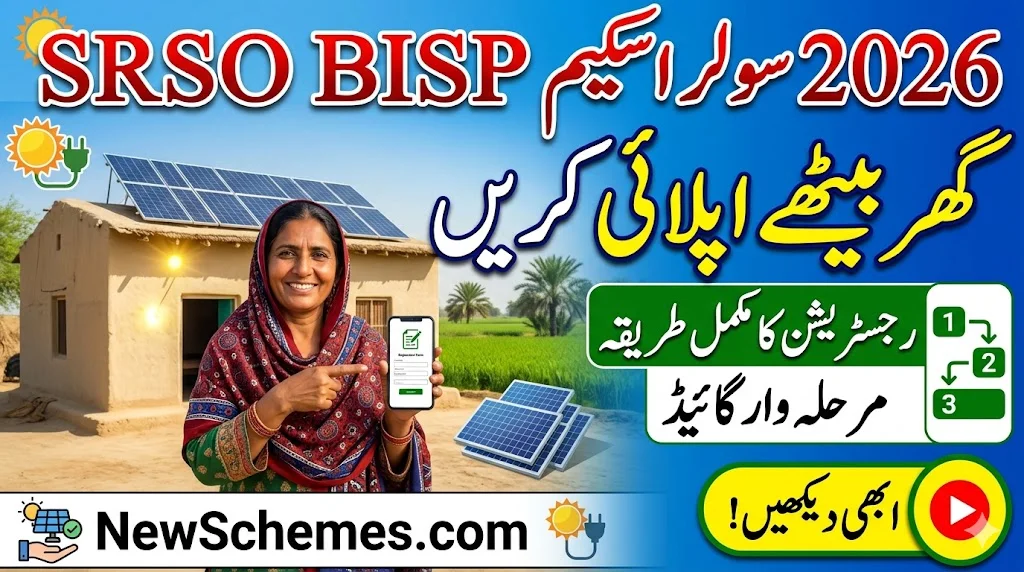
How to Apply for SRSO BISP Solar Scheme 2026 Step by Step Registration Guide Here
The SRSO BISP Solar System Program is a transformative initiative designed to provide renewable energy to the most vulnerable populations in rural Sindh. By targeting households already registered under the Benazir Income Support Programme (BISP), the project ensures that those living below the poverty line receive essential electricity. This collaborative effort between the Sindh Rural Support Organization (SRSO) and the provincial government addresses the energy crisis while reducing the financial burden on low-income families.
An Overview of the SRSO BISP Solar System Program
The SRSO BISP Solar System Program operates under the broader umbrella of the Sindh Solar Energy Project (SSEP). This initiative is heavily supported by the World Bank, which provides the necessary financial backing and technical frameworks to ensure sustainability. According to official data from the Sindh Energy Department, the project aims to provide solar home systems to approximately 200,000 households that lack access to the national grid.
Unlike traditional energy projects, the SRSO BISP Solar System Program prioritizes transparency and community involvement. By using the BISP National Socio-Economic Registry (NSER) as a primary filter, the program eliminates political favoritism and ensures that the equipment reaches genuine beneficiaries. To stay updated with such public welfare initiatives, readers often visit NewSchemes.com for the latest eligibility criteria and portal updates.
Step 1: Checking Eligibility for the SRSO BISP Solar System Program
The first critical step in accessing the SRSO BISP Solar System Program is verifying your current status in the BISP database. Only families with an active CNIC profile and a valid poverty score are considered for the solar distribution. Residents can check their eligibility by sending their 13-digit CNIC number to the 8171 SMS service or by visiting the official 8171 web portal.
Once a family confirms their BISP status, they become eligible for the SRSO BISP Solar System Program selection process. It is important to note that having a BISP card does not automatically guarantee a solar system, as the program specifically targets off-grid areas where electricity infrastructure is entirely absent or highly unreliable.
Step 2: Utilizing Local Support Organizations for the SRSO BISP Solar System Program
The implementation of the SRSO BISP Solar System Program relies on a grassroots network consisting of Community Organizations (COs) and Village Organizations (VOs). These groups work under the Local Support Organizations (LSOs) at the union council level. Beneficiaries must visit their local LSO office to formally express interest and request the “Solar Beneficiary Verification Form.”
During this phase, the SRSO BISP Solar System Program staff provides guidance on how to fill out the application. The LSOs act as a bridge between the remote villagers and the SRSO management, ensuring that the voices of the rural poor are heard and documented accurately.
Step 3: Required Documentation for the SRSO BISP Solar System Program
To process an application for the SRSO BISP Solar System Program, specific documentation is mandatory to prevent identity drift or fraud. Applicants must provide their original CNIC along with a clear photocopy. Additionally, proof of the most recent BISP installment or a copy of the BISP beneficiary card is required to validate the household’s economic status.
Furthermore, the SRSO BISP Solar System Program requires a recent photograph of the applicant’s home. This photograph helps technical teams assess whether there is adequate space on the roof or in the courtyard for a solar panel installation. Maintaining a transparent paper trail is essential for the World Bank’s auditing requirements.
Step 4: Household Verification Under the SRSO BISP Solar System Program
Physical verification is a cornerstone of the SRSO BISP Solar System Program to ensure that “ghost” beneficiaries do not exploit the system. An SRSO social mobilizer, often accompanied by a technical supervisor, will visit the applicant’s residence. They verify that the applicant is a permanent resident of the area and that the household actually meets the designated poverty criteria.
This site visit for the SRSO BISP Solar System Program also serves as a technical survey. The mobilization team checks for potential shading issues from trees or nearby structures that might hinder the efficiency of the solar panels. This ensures that once the system is installed, it provides the maximum possible wattage for the family’s needs.
Click And Apply
Step 5: Final Installation of the SRSO BISP Solar System Program Units
Once the verification is successful, the SRSO BISP Solar System Program enters the installation phase. Trained technicians arrive at the location to set up the solar panels, charge controllers, and battery storage units. This usually includes a 200W to 300W setup capable of powering multiple LED bulbs and a DC fan, which significantly improves the quality of life.
The final stage of the SRSO BISP Solar System Program involves beneficiary training. Technicians provide a brief tutorial on how to clean the panels to maintain efficiency and how to monitor the battery levels. Proper maintenance ensures that the system remains functional for years, providing a long-term solution to energy poverty.
Economic and Social Impact of the SRSO BISP Solar System Program
The impact of the SRSO BISP Solar System Program extends far beyond simple illumination. For a family earning a meager PKR 20,000 monthly, an electricity bill of PKR 3,000 or PKR 4,000 is a significant financial burden. By removing this cost, the program allows families to redirect their limited funds toward better nutrition, healthcare, and education for their children.
Moreover, the SRSO BISP Solar System Program empowers children to study after sunset and allows small-scale home-based businesses, such as tailoring, to operate during evening hours. The Sindh Energy Department and the World Bank continue to monitor these outcomes to justify future expansions of the project to other districts.
FAQs About the SRSO BISP Solar System Program
1. Who is eligible for the SRSO BISP Solar System Program?
Only households currently registered and receiving installments from the Benazir Income Support Programme (BISP) in designated rural areas of Sindh are eligible.
2. Is there any fee for the SRSO BISP Solar System Program registration?
No, the registration and installation process for the solar systems are completely free of charge for verified beneficiaries.
3. What equipment is provided under the SRSO BISP Solar System Program?
Beneficiaries typically receive a solar panel, a battery for energy storage, several LED bulbs, a DC fan, and a mobile charging port.
4. How can I find my local LSO for the SRSO BISP Solar System Program?
You can contact the SRSO regional office in Sukkur or Larkana, or ask village community leaders to guide you to the nearest Union Council-level Local Support Organization.
5. Does the SRSO BISP Solar System Program cover urban areas?
Currently, the program focuses on off-grid rural regions where traditional electricity infrastructure is unavailable.
6. Can I apply for the SRSO BISP Solar System Program if I am not in BISP?
The current phase of this project is strictly limited to BISP beneficiaries to ensure the most vulnerable populations are prioritized.
Conclusion
The SRSO BISP Solar System Program stands as a landmark initiative in Pakistan’s journey toward energy equity and poverty alleviation. By combining the financial strength of the World Bank with the administrative expertise of the Sindh Energy Department and the grassroots reach of the SRSO, the program delivers a sustainable energy solution to the doorstep of the poor. As thousands of homes transition from darkness to light, the socio-economic landscape of rural Sindh undergoes a profound change, proving that renewable energy is not just a luxury for the rich, but a vital tool for empowering the underprivileged. Through transparent registration and rigorous verification, this program ensures that the benefits of modern technology reach the right hands, fostering a more resilient and self-sufficient community.