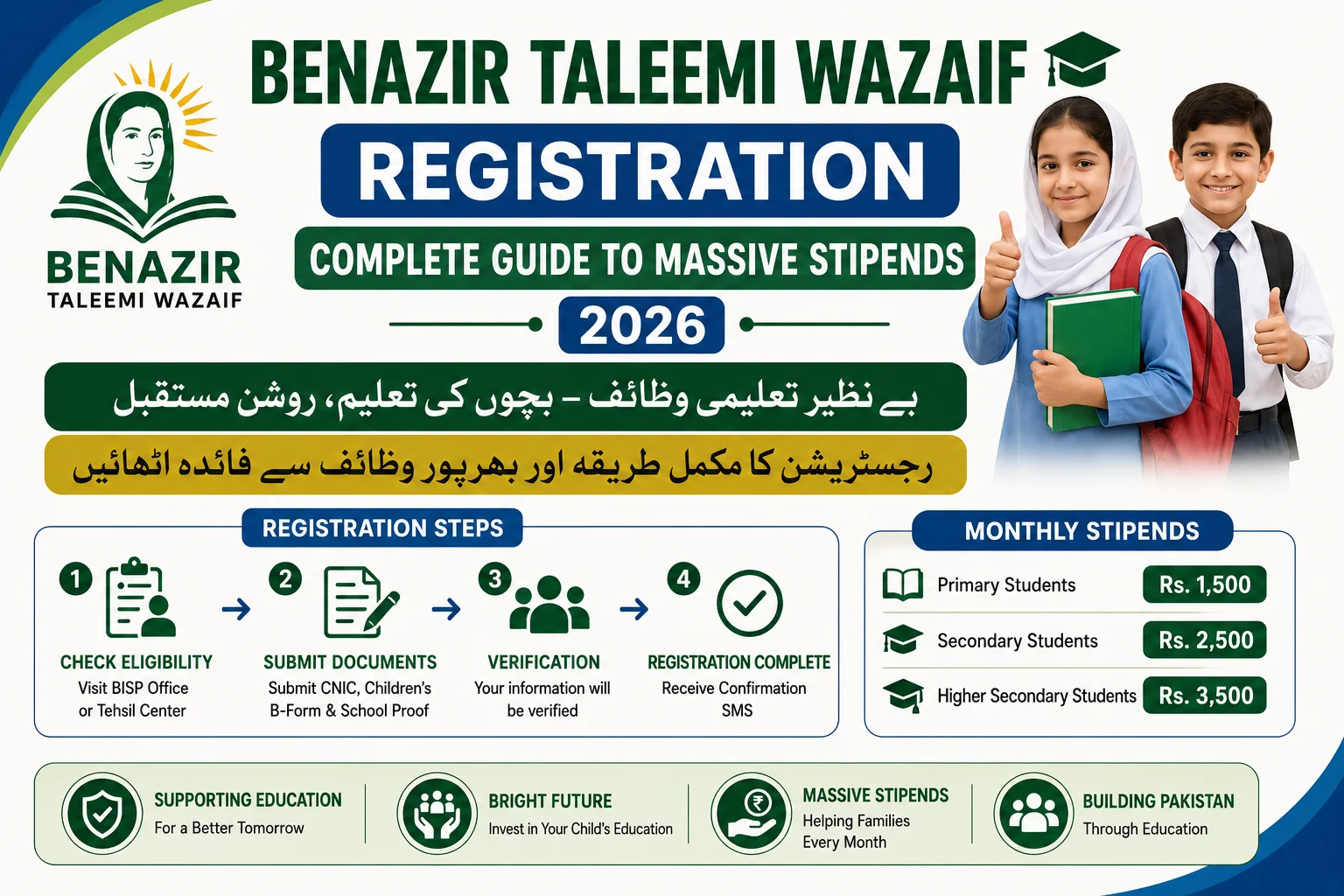
Benazir Taleemi Wazaif: Best Guide to Massive Stipends
Benazir Taleemi Wazaif is a strategic Conditional Cash Transfer (CCT) initiative focused on providing educational support to the children of active Benazir Income Support Programme (BISP) beneficiaries. By utilizing these additional cash incentives, the government motivates families to prioritize formal schooling for their children. The core mission is to bridge the gap between financial constraints and educational access for secondary and higher secondary students.
The programme specifically targets children of BISP Kafalat beneficiaries to minimize school dropout rates. By ensuring consistent student retention, Benazir Taleemi Wazaif creates a pathway for sustainable educational development across marginalized sectors. Families receive these stipends upon meeting specific attendance and enrollment benchmarks, fostering a culture of accountability and academic pursuit.
The Operational Framework of Benazir Taleemi Wazaif
Benazir Taleemi Wazaif operates with a clear vision to foster long-term awareness of the importance of primary, secondary, and higher secondary education. One of its main functional goals is to increase nationwide enrollment by providing targeted subsidies. Through these incentives, the system works to improve overall school attendance figures and significantly decrease the risk of children leaving the school system early.
A successful execution relies on multiple levels of coordination between national and local bodies. The primary stakeholders include the BISP administration, Provincial Education Departments, and local public and private schools. Furthermore, international donors support the fiscal requirements to keep the programme scalable. For updates on various educational initiatives, many citizens also monitor platforms like NewSchemes.com to track application windows.
Core Objectives and Strategic Goals of Benazir Taleemi Wazaif
Establishing Benazir Taleemi Wazaif was a deliberate move to transition from unconditional relief to development-oriented assistance. The programme aims to ensure that marginalized families do not see children as solely economic units but as future academic contributors. By tying financial aid to attendance, the strategy addresses the root cause of low literacy rates in impoverished regions and creates a sustainable awareness cycle.
Another vital aspect of Benazir Taleemi Wazaif is the emphasis on gender equality in education. The data consistently shows that female students often face higher barriers to enrollment. To counter this, the programme offers specific incentives tailored for girls, including a unique graduation bonus. This targeted approach ensures that economic vulnerability does not translate into domestic exclusion for young female learners.
Historical Growth and Geographical Reach of Benazir Taleemi Wazaif
Tracing the background of Benazir Taleemi Wazaif reveals a phased expansion strategy. The programme was initially successfully piloted in just five districts back in November 2012. By 2015, the scope widened to 32 districts, later reaching 50 in early 2018. The real acceleration occurred in 2020, where it initially hit 100 districts in January before being implemented in every single district of Pakistan by July 2020.
Throughout this journey, Micro Supply Capacity Assessment (MSCA) remained a fundamental pillar. Benazir Taleemi Wazaif relies on accurate data regarding supply capacity, assessing infrastructural conditions and catchment areas. Using data from provincial education departments, officials determine which areas require deeper mobilization to ensure that existing schools can handle the influx of newly registered students.
Registration and Administrative Processes of Benazir Taleemi Wazaif
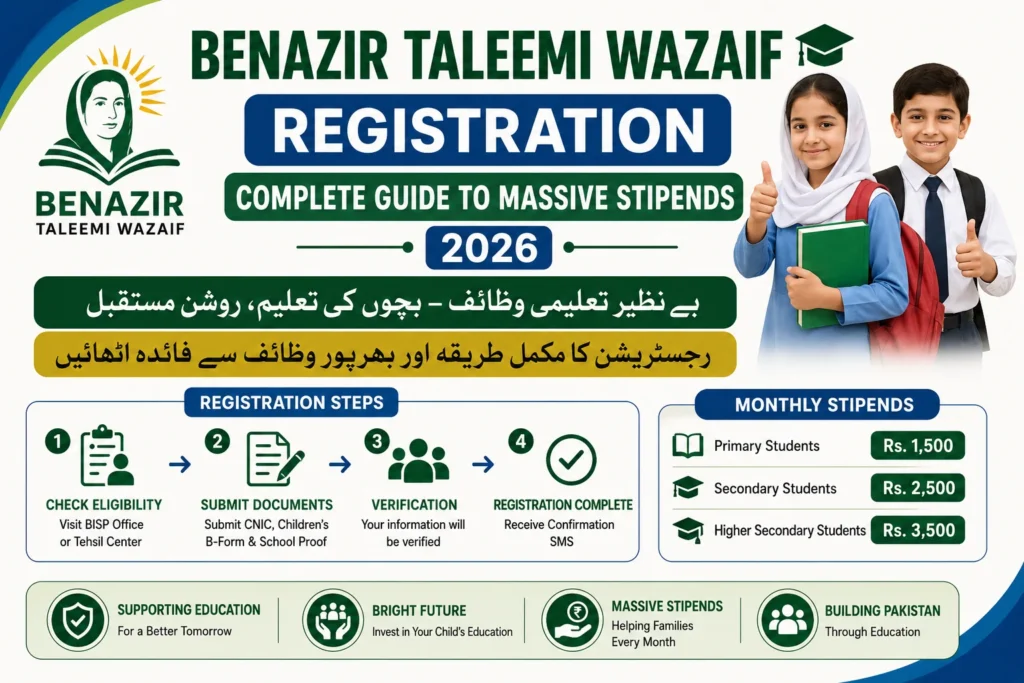
Benazir Taleemi Wazaif processes involve a dedicated social mobilization effort where field teams visit various localities. They engage directly with non-compliant families to understand and resolve reasons for low enrollment. Following mobilization, the formal registration of eligible children begins at tehsil offices. This process invites families to register primary (4-12 years), secondary (8-18 years), and higher secondary (13-22 years) students.
Verification is essential to the integrity of Benazir Taleemi Wazaif payments. Parents must provide the Mother’s CNIC, the Nadra-issued B-form/CRC, and a verified school admission slip. No student is fully enrolled until their CRC status is cleared via the NADRA database. This meticulous management strategy ensures that public funds are utilized exclusively by eligible beneficiaries who meet the enrollment criteria.
Co-Responsibilities and Compliance in Benazir Taleemi Wazaif
Benefit disbursement through Benazir Taleemi Wazaif is strictly conditional upon 70% quarterly attendance. In the first quarter, payout is triggered by initial enrollment verification. However, from the second quarter onwards, cash incentives depend on the child maintaining consistent school attendance. Failure to meet these conditions triggers a non-compliance alert, and three consecutive failures lead to suspension from the programme.
To maintain efficient standards, Benazir Taleemi Wazaif incorporates a Case Management system. This allows beneficiaries to lodge complaints through field offices regarding payment errors or non-compliance notices. Field officials prioritize these resolutions to build trust within the community. Active case management significantly bolsters confidence in the academic system’s transparency and fairness.
Financial Stipends and Statistics of Benazir Taleemi Wazaif
A detailed look at the financial structure of Benazir Taleemi Wazaif reveals hierarchical support per level. At the primary level, boys receive Rs. 1,500 and girls Rs. 2,000 per quarter. The amount increases at the secondary level (Boys 2,500 / Girls 3,000) and peaks at the higher secondary level (Boys 3,500 / Girls 4,000). Notably, a girl who completes primary education receives a Rs. 3,000 one-time graduation bonus.
Recent figures highlight massive growth; since inception, Benazir Taleemi Wazaif has enrolled approximately 12.01 million children. Of these, over 9.3 million are in primary school, 2.4 million in secondary, and nearly 300,000 in higher secondary. Total disbursement has crossed 63.34 Billion PKR, with the annual payout growing from 84 million PKR in 2014 to over 23 billion PKR in the 2022-23 cycle alone, reflecting the massive scaling operations.
FAQs About Benazir Taleemi Wazaif
1. Who is eligible for Benazir Taleemi Wazaif?
Eligibility is restricted to children of active BISP Kafalat beneficiaries within specified age brackets (4-12 for primary, 8-18 for secondary, and 13-22 for higher secondary).
2. What is the attendance requirement for Benazir Taleemi Wazaif?
To receive payments after the first quarter, students must maintain at least a 70% attendance record in their respective schools or colleges.
3. Is there any extra bonus for girls’ education under Benazir Taleemi Wazaif?
Yes, girls receive higher quarterly stipends compared to boys and are eligible for a one-time Rs. 3,000 bonus upon completing their primary education.
4. Which documents are mandatory for registration in Benazir Taleemi Wazaif?
Beneficiaries must present the mother’s original CNIC, the child’s NADRA B-Form, and an admission slip verified by school authorities.
5. How often is the stipend distributed in Benazir Taleemi Wazaif?
The educational stipends are disbursed on a quarterly basis, pending verification of school attendance and enrollment compliance.
6. What happens if a child stops going to school in the Benazir Taleemi Wazaif system?
Non-compliance results in the suspension of cash transfers. If a child fails the attendance threshold for three consecutive quarters, they are suspended from the program.
Conclusion
In conclusion, Benazir Taleemi Wazaif stands as one of the most successful educational intervention programs in the national history of Pakistan. By directly linking social welfare with educational co-responsibilities, it has not only increased enrollment to over 12 million children but also incentivized families to keep girls in school. With a disbursement tallying over 63 billion PKR, the program significantly alleviates the financial burden on low-income households. The continued efforts in digital verification, social mobilization, and field monitoring suggest that Benazir Taleemi Wazaif will remain a cornerstone of national development policy, ensuring better long-term academic outcomes for millions.