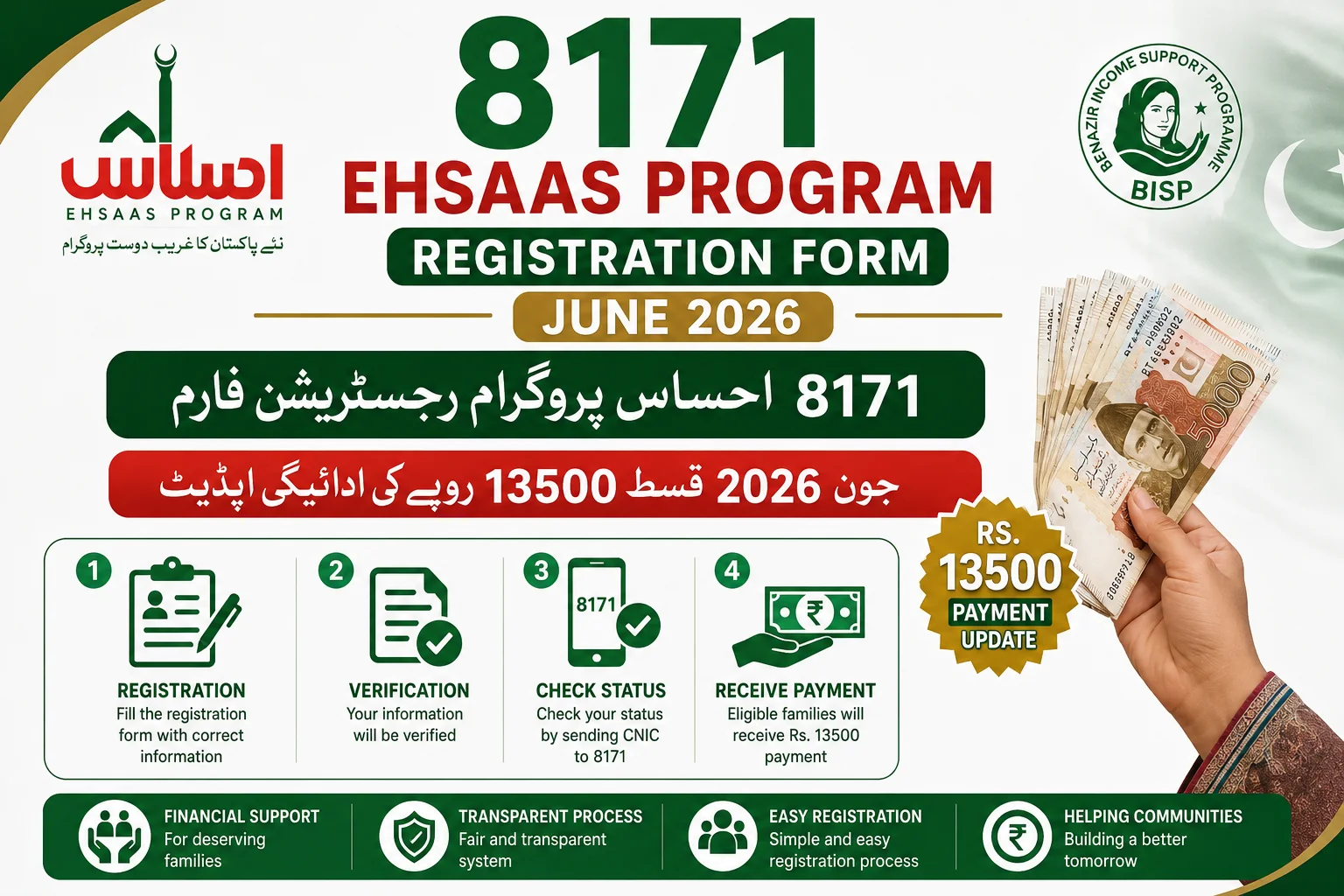
8171 Ehsaas Program: Crucial Rs 13500 Payment Relief
The 8171 Ehsaas Program Registration Form 2026 Rs 13500 Payment Update for June 2026 is providing crucial financial relief to countless low-income families across Pakistan. With the persistent rise in daily living expenses, from groceries and medicines to education and essential utility bills, the latest disbursement of Rs. 13,500 has been eagerly anticipated. Amidst various rumors circulating on social media regarding changes to registration procedures and potential payment delays, it is vital for beneficiaries to access accurate and official information.
This article aims to clarify the most recent updates for May and June 2026 in straightforward terms. It will detail the current eligibility criteria, outline the official registration methods, list the necessary documents for application, and provide guidance for individuals who may initially be declared ineligible. The program, a cornerstone of Pakistan’s social safety net, continues its mission to uplift the most vulnerable segments of society.
Latest Rs. 13,500 Payment May 2026 Check
Enter your CNIC number to check your BISP 8171 payment status and eligibility.
Understanding the 8171 Ehsaas Program and June 2026 Payment Update
The 8171 Ehsaas Program operates as a significant component under the umbrella of the Benazir Income Support Programme (BISP). Its core objective is to deliver vital financial assistance to financially vulnerable households throughout Pakistan, thereby mitigating the severe impacts of poverty and inflation. This initiative serves as a lifeline for many families struggling to meet their basic needs.
Applicants have access to several official services to ascertain their eligibility and check the status of their payments. These include the user-friendly 8171 SMS service, the dedicated 8171 online portal, and the National Socio-Economic Registry (NSER) Dynamic Survey. These integrated services ensure a broad reach and accessibility for all potential beneficiaries seeking support.
Latest Rs 13,500 Payment Update for June 2026
According to the most recent information, eligible beneficiaries are slated to receive an amount of Rs. 13,500, following successful verification of their details against NADRA and NSER records. This regular disbursement is a key feature of the program, designed to provide consistent support. The payment for June 2026 builds upon the previous cycle, reflecting the program’s ongoing commitment.
Payment highlights for this crucial period include a standard amount of Rs. 13,500 designated for the month of June 2026. Crucially, successful verification through NADRA and NSER remains a prerequisite for disbursement. Payments are typically processed via biometric verification, reinforcing security and transparency. Some beneficiaries might encounter brief delays if their household records require updates or are currently under review.
Eligibility for the Rs 13,500 Payment in the 8171 Ehsaas Program
The 8171 Ehsaas Program is specifically designed to support deserving households grappling with financial hardship. The program’s scope is broad, ensuring that assistance reaches those most in need across various demographics. The target beneficiaries are identified through a meticulous process involving poverty score assessment.
Eligible applicants primarily include low-income families who fall below a certain poverty threshold. Widows, unemployed individuals, and single mothers are also key recipients, reflecting the program’s focus on vulnerable groups. Women beneficiaries are often prioritized, acknowledging their significant role in household well-being. Furthermore, individuals already registered in the NSER database and those possessing valid CNICs are generally considered for the Rs 13,500 payment. Final approval is contingent upon successful document verification and the applicant’s assessed poverty score.
Criteria for 8171 Ehsaas Program Registration Form 2026
To qualify for assistance through the 8171 Ehsaas Program, applicants must typically adhere to a stringent set of requirements. These criteria are established to ensure that aid is directed towards the most deserving segments of the population while maintaining fairness and accountability. Meeting these conditions is the first step towards receiving support.
Applicants must be Pakistani citizens and possess a valid Computerized National Identity Card (CNIC). They should belong to a financially weak household, identified by a Poverty Mean Test (PMT) score within the approved range, which usually indicates severe financial distress. Important disqualifiers include holding a government job or being an active tax filer. Additionally, having updated NSER survey information is critical for accurate assessment and continuation of benefits. For detailed information, visit NewSchemes.com.
How to Apply for the 8171 Ehsaas Program Registration Form
Prospective beneficiaries seeking to avail the 8171 Ehsaas Program can register through two primary official channels, designed to accommodate varying levels of internet access and technological proficiency. These methods streamline the application process and enhance accessibility. Adhering to these official procedures is key to a smooth registration process.
Method 1: Online Registration Through 8171 Portal
Applicants with internet access can visit the official BISP 8171 portal. Here, they are required to enter their 13-digit CNIC number, followed by completing a security verification step. Once these initial checks are complete, they can submit the application form. Eligibility confirmation is typically sent via SMS, providing a convenient update.
Method 2: Registration Through SMS
For individuals without internet access, the SMS method offers an accessible alternative. By simply opening their mobile messaging application, applicants can type their 13-digit CNIC number, ensuring no dashes are included, and send it to 8171. An eligibility response will be received via SMS, confirming their status without needing online access. This method significantly broadens the program’s reach.
Required Documents for 8171 Ehsaas Program Registration 2026
Before initiating the registration process for the 8171 Ehsaas Program, applicants are advised to prepare a set of essential documents. Having these documents readily available can significantly expedite the application and verification process. Accurate and complete documentation is crucial for eligibility assessment.
Key documents include the original Computerized National Identity Card (CNIC) of the applicant. A mobile SIM card registered in the applicant’s name is also necessary for communication and verification purposes. Detailed household information and current income details are requested to assess the financial standing. In some cases, a copy of a utility bill might be requested for address verification. Furthermore, specific certificates such as widow, disability, or death certificates are required if applicable to the applicant’s circumstances.
Addressing Ineligibility in the 8171 Ehsaas Program
Receiving an “ineligible” response for the 8171 Ehsaas Program does not necessarily mean a permanent rejection. Many applicants can become eligible after taking corrective actions to update their records or clarify their status. Understanding the steps to reapply is crucial for those initially deemed ineligible.
Steps to Reapply for the 8171 Ehsaas Program:
A crucial step is to visit the nearest BISP Tehsil Office to explain your situation and seek guidance. Updating household information through the NSER Dynamic Survey is often necessary, as outdated data is a common reason for ineligibility. Correcting any errors or discrepancies in NADRA records is also vital. After completing these updates, applicants should wait for re-verification. A significant number of individuals successfully transition to eligible status after addressing these issues, highlighting the importance of proactive follow-up.
New Payment System for the 8171 Ehsaas Program in 2026
Reflecting a commitment to efficiency and security, BISP has significantly enhanced its payment system for the 8171 Ehsaas Program in 2026. These advancements build upon existing infrastructure, aiming to improve the overall beneficiary experience. The new system leverages technology to streamline financial disbursements.
The bolstered payment system incorporates robust biometric verification, ensuring that funds reach the intended recipients directly and securely. Digital tracking capabilities have also been integrated, allowing for greater transparency and oversight of transactions. These improvements make payments faster, more secure, and easier to monitor. Ultimately, this upgraded system plays a vital role in reducing instances of fraud and preventing unauthorized deductions, safeguarding the financial assistance provided to deserving families.
Common Challenges with 8171 Ehsaas Program Registration
While the 8171 Ehsaas Program strives for accessibility, applicants sometimes encounter various issues during the registration and payment process. Awareness of these common problems can help beneficiaries navigate the system more effectively and avoid unnecessary delays. Proactive troubleshooting can often resolve these hurdles efficiently.
Frequent challenges include submitting incorrect CNIC numbers, which can lead to processing errors. Outdated NSER records are another significant hurdle, as these form the basis of eligibility assessment. Issues with SIM cards not being registered in the applicant’s name can impede communication and verification. Biometric verification failures, often due to biometric data discrepancies, can also cause delays. Furthermore, beneficiaries must be wary of fake SMS messages and unauthorized agents who may attempt to charge fees for services that are officially free.

Safety Tips for Beneficiaries of the Ehsaas Program
Protecting oneself from fraudulent activities is paramount for all beneficiaries of the 8171 Ehsaas Program. Scammers frequently target vulnerable individuals, making it essential to remain vigilant and informed about secure practices. Adhering to official guidelines can prevent financial loss and exploitation.
Always trust only messages that originate from the official 8171 number; any other sender is likely fraudulent. Crucially, never share One-Time Password (OTP) codes or personal banking details with anyone, even if they claim (Note: MAX_TOKENS) to be program officials. Avoid paying anyone for registration or assistance with the program, as all official services are free. Steering clear of unofficial agents and always keeping payment receipts safe are also critical safety measures